
A Recent Section 114(1A) Charge Just Put a Question in Front of Every Malaysian Tax Professional
Not “did you make a mistake.” The real question is narrower, sharper — and most practitioners have never had to answer it under pressure.
On 2 September 2026, an accounting firm partner was charged in the George Town magistrate’s court — not the taxpayer, not the director, the preparer. Chew Ai Keow, 63, of Abbacus Cloud Solutions, was charged with assisting and advising Penshrimp Fishery Sdn Bhd to submit income tax returns that allegedly resulted in RM2,526,144.24 of under-reported tax. She pleaded not guilty and is claiming trial. Nothing in this article is a comment on the guilt or innocence of anyone involved — the facts remain to be tried in court.
But the charge alone puts a specific, uncomfortable question in front of every accountant, tax agent, auditor, director and finance head reading this:
If your assistance or advice helped produce this year’s tax position — could you prove, on paper, right now, that you exercised reasonable care?
Not “I’m generally careful.” Prove it. In writing. To someone who wasn’t in the room.
Most practitioners have never had to answer that under real pressure. This case is the reminder that someone eventually will.
The Questions This Case Puts on the Table
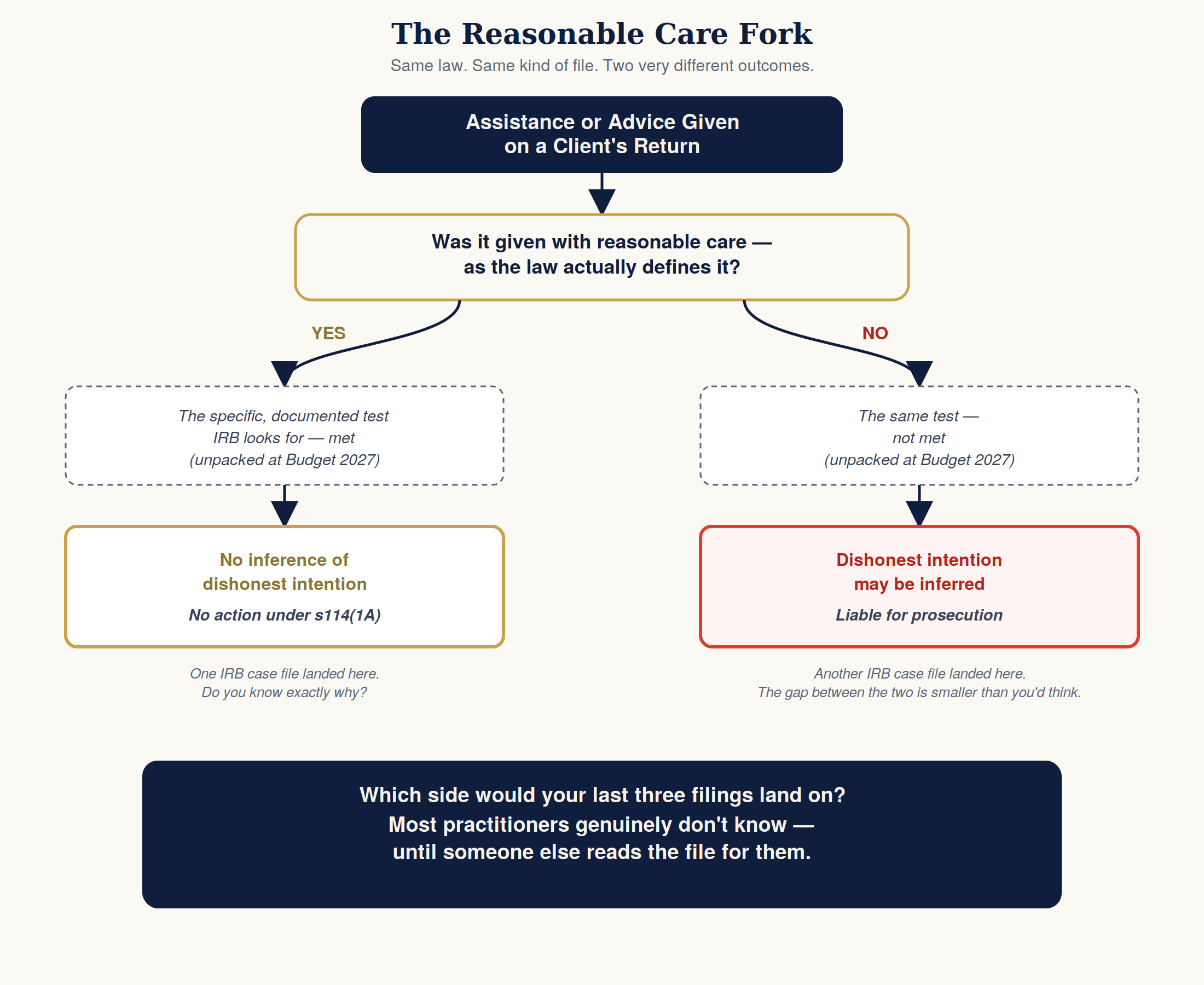
- Malaysian law has an exact, official definition of “reasonable care.” Would your own working papers actually meet it — or just feel like they would?
- IRB’s own PR8/2000 shows two professionals facing near-identical situations — one walked away with no action taken, one now sits in the exposure column. What’s the one factor that separated them?
- If a client’s figures don’t reconcile and you raise it once, verbally, are you protected? The legal answer surprises most people who’ve never checked.
- We’ve distilled IRB’s enforcement pattern — this case, and the Public Ruling’s own worked examples — into five specific categories of file a defensible engagement needs. How many of the five could your firm actually produce on demand, today, for your riskiest client?
- A director isn’t shielded just because the accountant is the one being charged. Where exactly does your own exposure start?
Every one of these has a specific, defensible answer under the Income Tax Act 1967, read together with the Public Ruling. We unpack all five — with the actual IRB case files, not hypotheticals — at Budget 2027.
In This Briefing
- What Actually Happened
- The Provision Is Old. The Attention Is New.
- What Section 114(1A) Actually Says
- Two IRB Case Files, Opposite Outcomes
- One Gap. Two Endings. (The Comic)
- Section 114(1) vs. Section 114(1A)
- Four Roles. Four Questions.
- The Excuses IRB Has Already Heard
- Five Files. One Honest Question.
- Questions Worth Bringing With You
Prefer to Read This as a Booklet?
Download the full briefing as a formatted PDF — every section, every diagram, every case file, laid out for printing or sharing with your team.
Download the Booklet (PDF) ↓What Actually Happened
According to NST’s reporting from the George Town magistrate’s court, Chew Ai Keow allegedly assisted and advised Penshrimp Fishery Sdn Bhd to submit income tax returns to the IRB director-general by checking and approving sales ledgers that excluded RM10.68 million in sales transactions from the company’s bank statements. The offence is alleged to have occurred at the company’s Hexagon Tech Park address in Penang between January and March 2021, while Chew was serving as the company’s accounting provider. The omission resulted in RM2,526,144.24 of under-reported tax in the company’s Form C for the 2020 year of assessment, submitted to LHDN on 25 March 2021.
Chew pleaded not guilty and claimed trial. IRB prosecuting officer Azniwati Yahya appeared for the prosecution; lawyer N. Dylan represented Chew. The prosecution offered bail at RM10,000 with one surety; the defence appealed for a lower amount, citing Chew’s family, permanent job in Penang, and low flight risk. The court granted bail at RM4,000 with one surety, and fixed 28 October for mention and submission of documents.
The size of the number isn’t what makes this worth your attention. It’s who was charged. Enforcement attention has traditionally concentrated on the taxpayer and the company. This case puts the preparer — the person who checked and signed off — in the dock. If that’s your role, the next question is unavoidable: what, specifically, currently separates your file from this one?
The Provision Is Old. The Attention Is New.
Section 114(1A) is not a fresh addition to the Income Tax Act 1967 — it was inserted by Act A1069 of 1999, taking effect on 1.1.2000, and has sat quietly beside s114(1) (wilful evasion) ever since, addressing a narrower situation: assistance or advice given in connection with someone else’s return. The official guidance on how it applies — HASiL Public Ruling No. 8/2000, effective 1 January 2001 — has governed this area for close to a quarter of a century. Most practitioners have treated it as a footnote. The question is whether their own files would survive it being read closely for the first time.
What Section 114(1A) Actually Says
Per the Public Ruling, where a person assists in, or advises with respect to, the preparation of a tax return and that assistance or advice results in an understatement of another person’s tax liability, the person giving that assistance or advice may be liable for prosecution if it can be construed that there was dishonest intention on their part to help the other person evade tax.
LHDN does not need to prove you personally benefited. It needs grounds to infer dishonest intention. The way that inference is rebutted has an official name — but knowing the name and being able to demonstrate it under audit pressure are two very different things.
The Official Definition of “Reasonable Care”
Per Public Ruling No. 8/2000: the degree of care or conscientiousness in paying proper attention to a task that is expected, in a similar situation, of an ordinary person who, considering the circumstances and the foreseeable consequences, acts with reason, sound judgment and responsibility — in good faith, based on the inquiries any reasonable person would have made.
That’s the legal standard, word for word. Here’s the harder question it raises: who decides, after the fact, whether your inquiries were the ones “any reasonable person” would have made — and what does the file need to look like for that argument to actually hold?
Two IRB Case Files. Same Kind of Trust Placed in a Client. Opposite Outcomes.
IRB’s own Public Ruling walks through worked examples of how this actually plays out. Two of them sit close enough together that they’re worth reading side by side.
Case File: The Bookkeeper
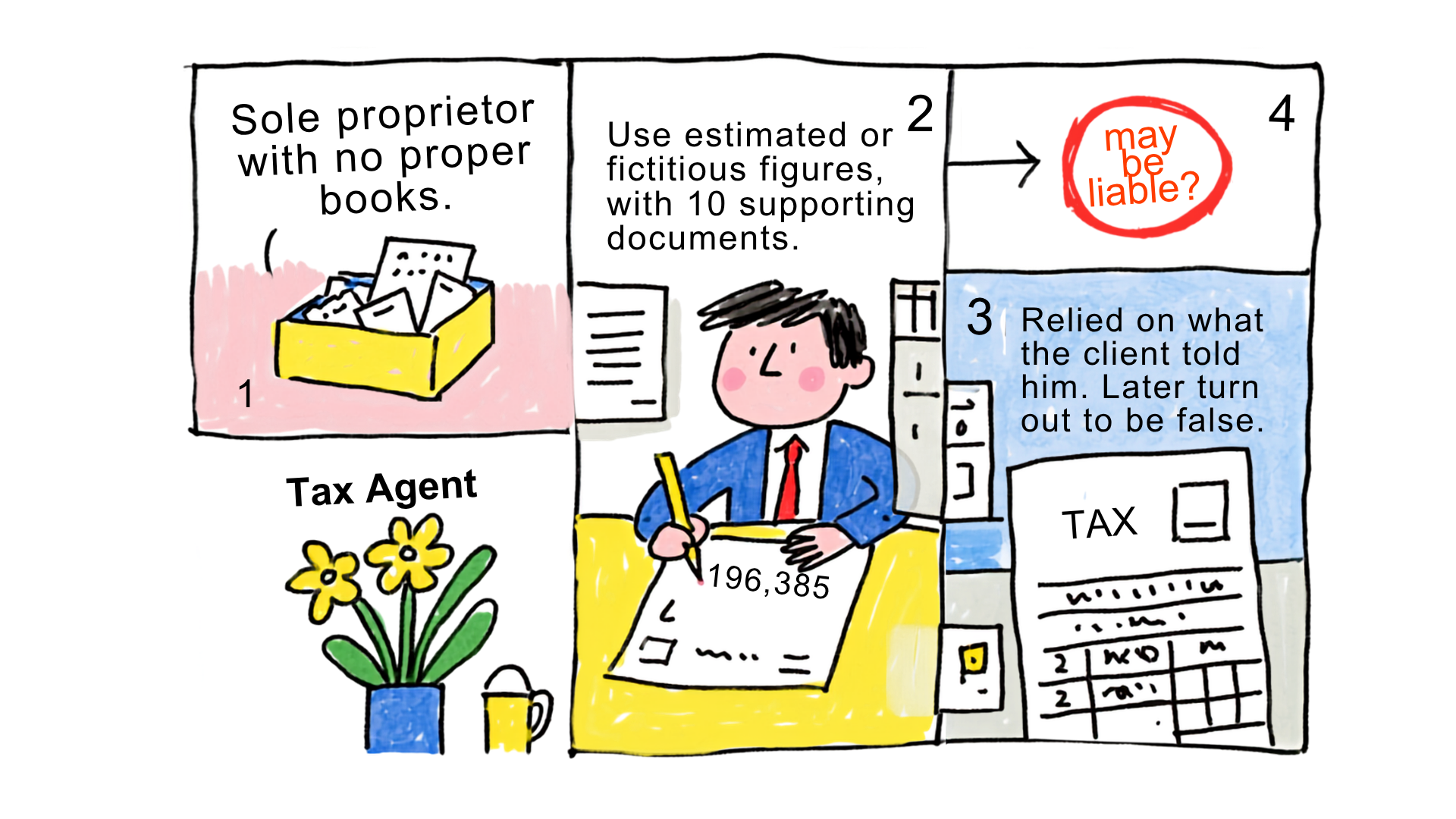
A sole proprietor with no proper books engaged a bookkeeper to prepare final accounts and the tax return from estimated or fictitious figures, with no supporting documents. IRB’s own conclusion: the bookkeeper may be liable under s114(1A).
Case File: The Tax Agent
A tax agent spotted a suspicious donation buried in a client’s expense claim, made inquiries, and relied on what the client told him. The client’s information later turned out to be false. IRB’s own conclusion: no action should be taken against the tax agent.
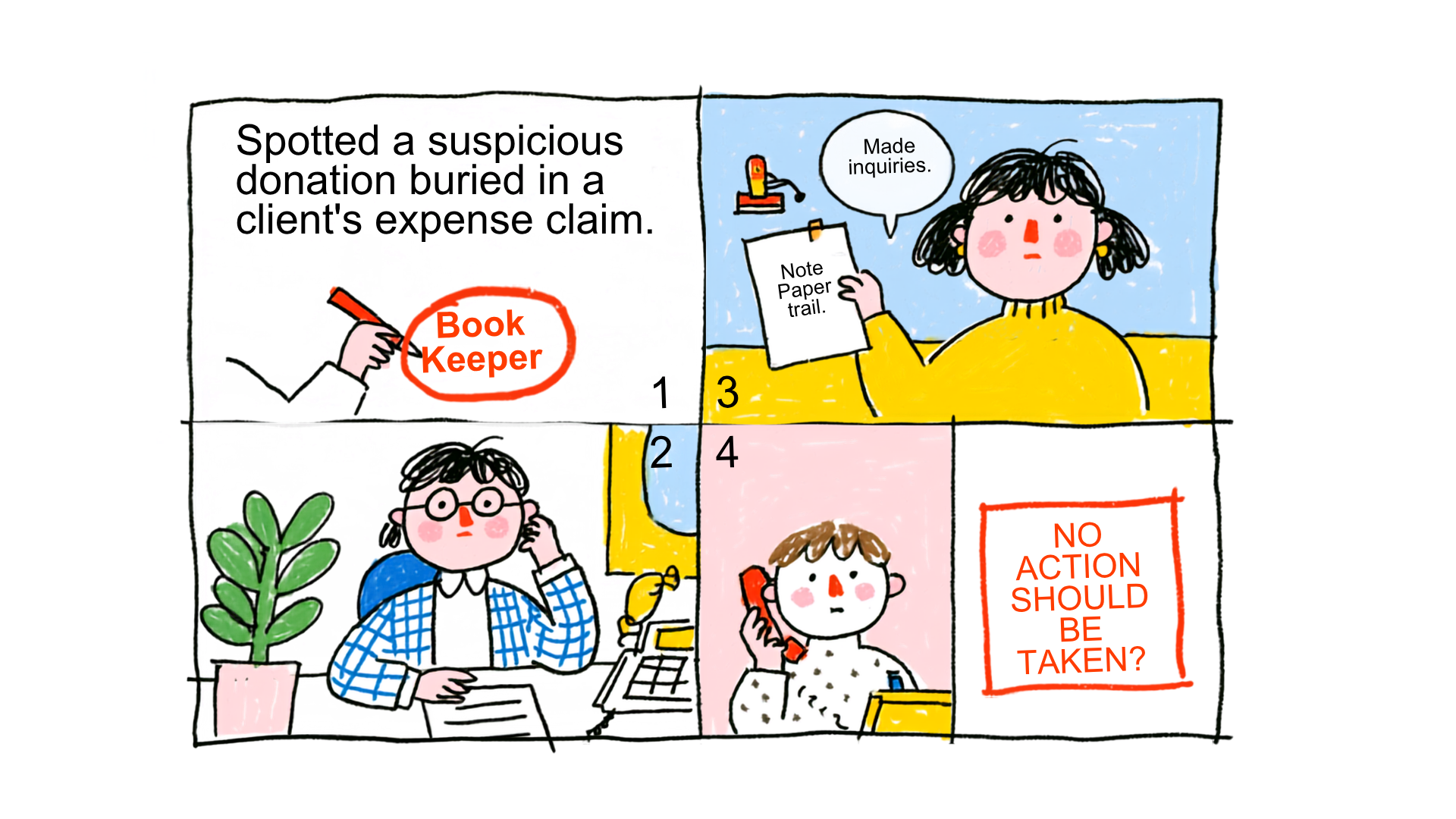
Same root problem in both cases: a professional relied on information from a client that turned out to be wrong. One faces prosecution. One doesn’t. What’s the one, specific, repeatable action that separated them — and is it currently built into how your firm handles every engagement, or does it only happen when someone happens to think of it?
IRB’s ruling names the exact factor explicitly. It’s not complicated once you see it — but very few firms have it as a standard operating procedure rather than a lucky habit. That’s the gap we close, file by file, at Budget 2027.
One Gap. Two Endings.
This isn’t the case above — it’s a composite, the kind of scene that plays out in review meetings everywhere. But it’s the exact fork the case above turns on.
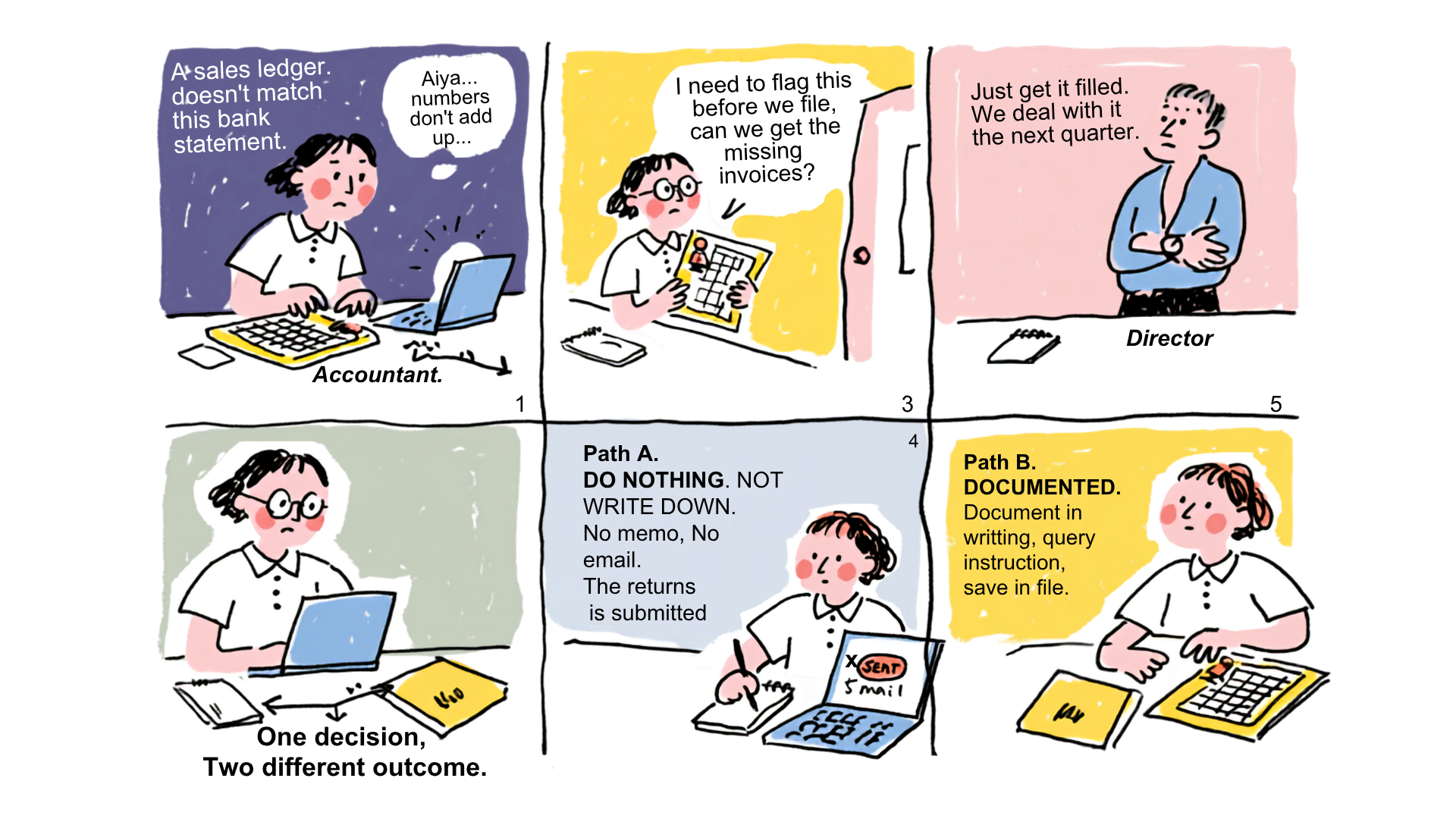
Same conversation. Same pressure to file on time. The only difference between Panel 4 and Panel 5 is eleven minutes spent writing an email that never got sent in the real world — because in most firms, it never occurs to anyone that eleven minutes is the whole case.
Section 114(1) vs. Section 114(1A): Two Different Questions
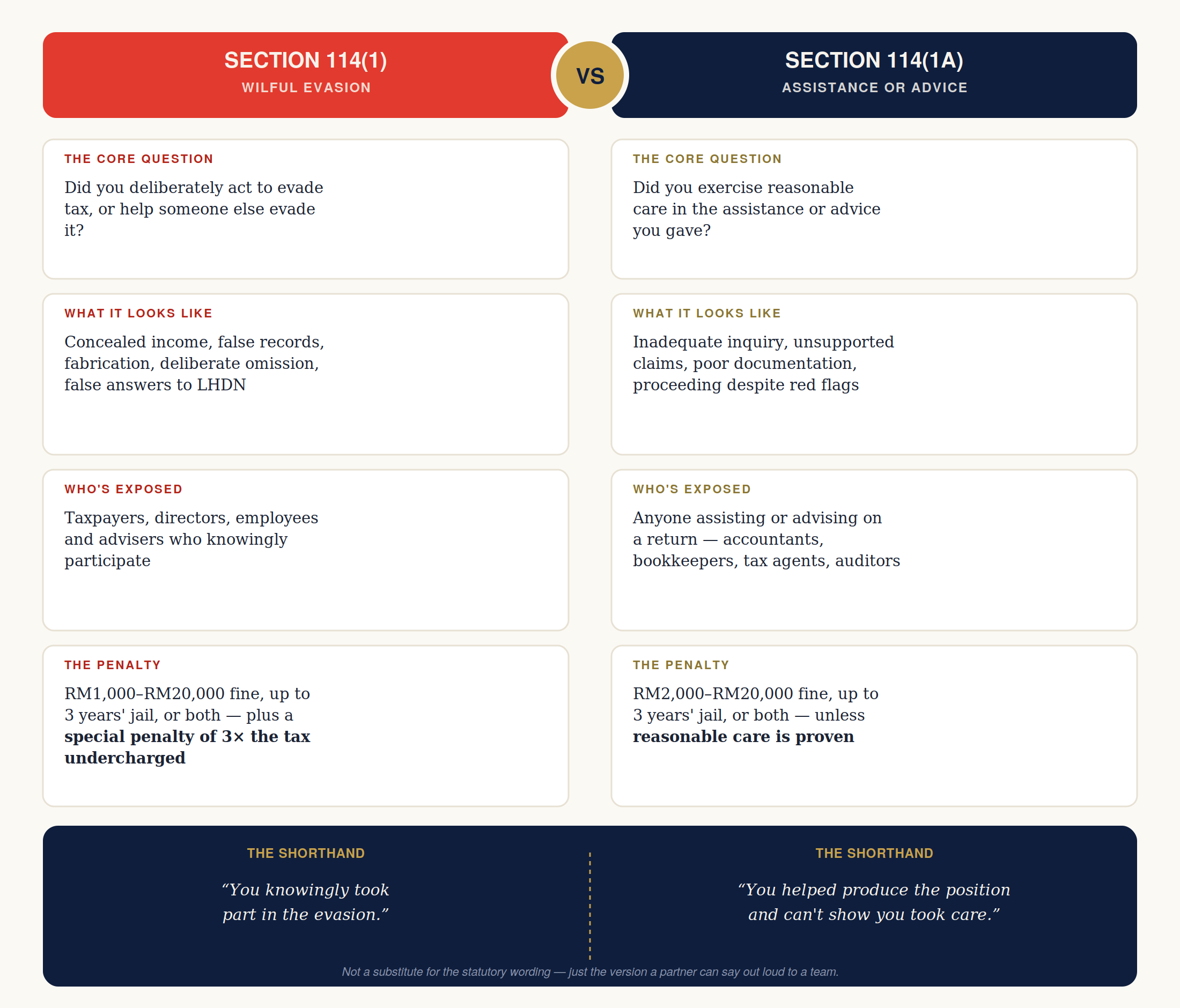
Here’s the uncomfortable follow-on question this infographic doesn’t answer: if IRB opened an investigation tomorrow, which of these two provisions would your own conduct on your riskiest current file most closely resemble — and would you know that before or after they told you?
Four Roles. Four Questions. Are You Exposed and Don’t Know It?
Tax Agents, Accountants & Bookkeepers
If IRB pulled your file on your riskiest client tomorrow, would it show the pattern that kept the tax agent in this article out of the dock — or the pattern that put the bookkeeper in it?
Company Directors
Your accountant can now be personally charged for signing off on your numbers. IRB’s own rulings show directors prosecuted too — for the instruction, not just the outcome. What does your own signature on this year’s return currently expose you to?
CFOs & Finance Heads
You’re usually the first person to see a reconciliation gap before anyone else does. If you were asked, under oath, what you did the last time that happened — would your answer be a memory, or a document?
In-House Tax & Compliance Executives
Your working papers are your defence file before they’re anything else. If your firm was audited tomorrow, how many of your active engagement files could actually prove that — today, without anyone rebuilding the story after the fact?
The Excuses IRB Has Already Heard
Every line below has been said, in some form, in a real file. IRB’s own rulings and this case show exactly where each one lands — and it’s rarely where the person saying it expected.
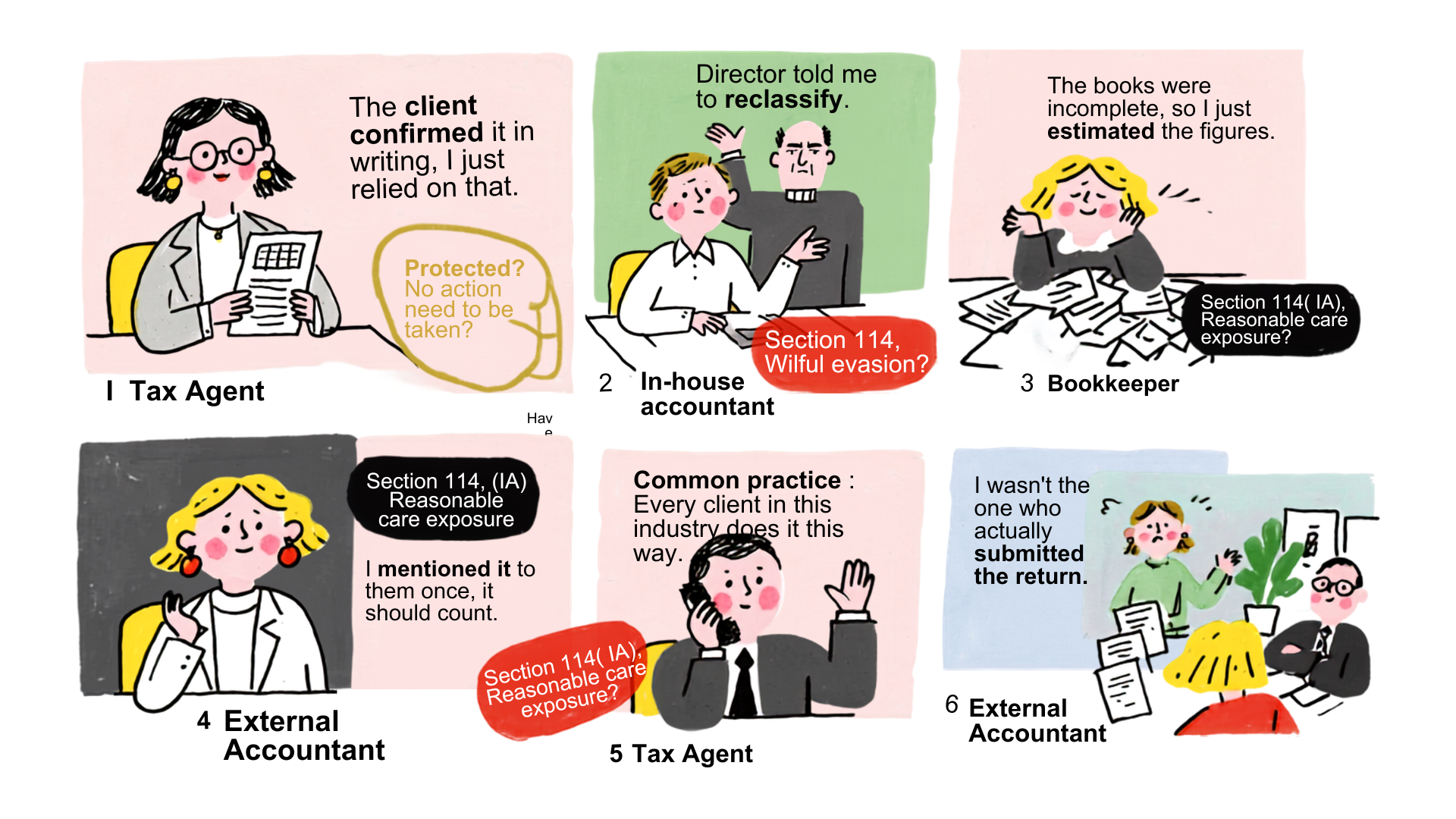
Notice the pattern: it’s not the excuse itself that decides the charge. It’s whether the excuse is backed by something written down before the return was filed. The one card that survives contact with an audit isn’t the cleverest excuse — it’s the only one with a paper trail behind it.
Which of these six have you said, out loud, in the last twelve months? That’s the file to pull first — before someone else pulls it for you.
Five Files. One Honest Question.
Reading this case against the Public Ruling’s own worked examples, we’ve built the pattern into five specific categories of file a defensible engagement needs — Synergy TAS’s own framework for what “reasonable care” actually looks like on paper, not a category IRB itself names. Not five ideas. Five specific, producible documents.
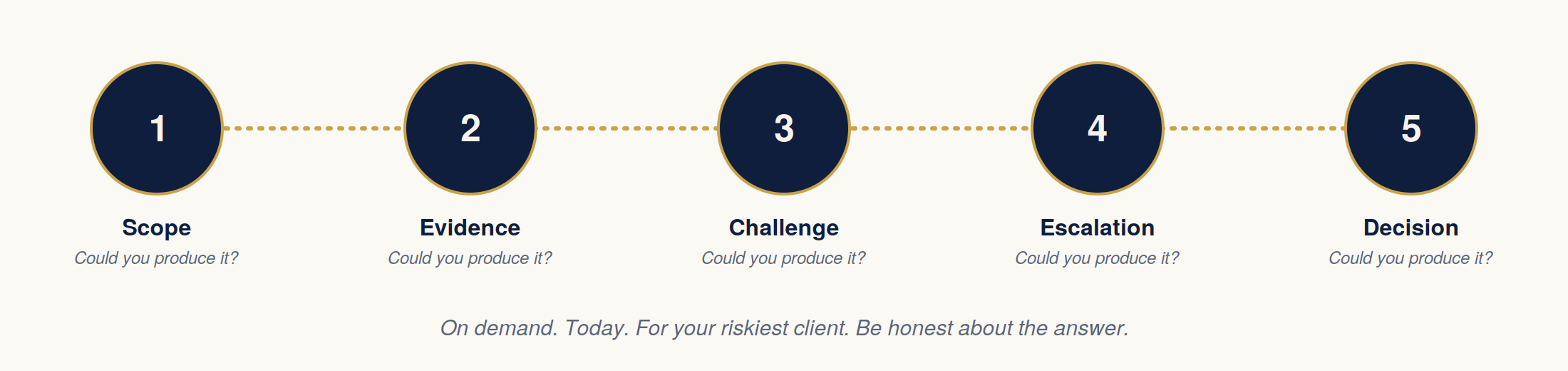
Ask yourself, right now, for the one client file that worries you most: could you hand over a Scope File that shows exactly what you were and weren’t engaged to check? An Evidence File of what you actually saw before advising? A Challenge File of what you queried and what came back? An Escalation File showing who reviewed the hard call? A Decision File recording the final call and who made it — not just what everyone assumes happened?
If the honest answer is one or two out of five, you’re not alone — and there’s no guarantee the same outcome would go your way either. Building all five, and leaving with a concrete action plan you can put in motion on Monday, is the core of what we walk through at Budget 2027.
Questions Worth Bringing With You
If you’re weighing whether Budget 2027 is worth three days out of your calendar, these are the specific questions the reasonable-care session is built to answer — bring them, and leave with the answer instead of the question:
- What exactly is the documented test that separates a defensible technical judgment from a s114(1A) exposure — not the general concept, the actual test?
- If a client instructs me to proceed despite a discrepancy I’ve raised, what specifically do I need on file before I do?
- Where does my firm’s engagement letter currently protect us — and where, honestly, does it not?
- What does a director’s own exposure look like when the accountant, not the director, is the one being charged?
- How do the Five Files actually get built into a normal engagement without doubling everyone’s workload?
Bring the Question. Leave With the Answer.
At Budget 2027, we open the actual case files — this one and others — and walk through the specific, documented test that determines which side of the reasonable-care fork a professional lands on. For tax agents, directors, CFOs and finance teams who’d rather know the answer before an audit letter forces the question.
See Budget 2027 Seminar Dates →Kuala Lumpur, 11–13 November 2026 — The Gardens Hotel, Mid Valley City.
Johor Bahru, 26–28 January 2027 — DoubleTree Hotel.
This article discusses a case reported by the New Straits Times (“Accountant charged with helping company under-report RM2.5mil in tax,” 2 September 2026) and general guidance from HASiL Public Ruling No. 8/2000 (“Wilful Evasion of Tax and Related Offences,” effective 1 January 2001). It is provided for general educational discussion only, is not legal or tax advice, and is not a comment on the guilt or innocence of any party in an ongoing matter. The named individual has pleaded not guilty and is claiming trial; nothing in this article should be read as a finding of fact. Confirm your own position with a licensed tax agent before acting.
